
Your HRV Fatigue Plan Download
Free worksheet for designing your personal HRV Fatigue Management Plan

I have spent many years designing systems to make life managing multiple and constant symptoms easier. My most recent one is finetuning a system I created for pain management.
The short version is that I realised I needed to catch my pain before it climbed high enough to trigger the nervous system, creating a cascade of pain signals that was very hard to deescalate. I created an If This Then That plan - a plan for each level on the pain scale. This plan reduced my flares and shortened them. You can read more about it and download the free worksheet here.
This is using the same principle but for fatigue.
My fatigue story, how this plan came about:
I’ve lived with chronic fatigue for 20 or so years. Subject fatigue rating scales no longer make sense for me. It’s all relative.
As I’ve improved over the past several years and was able to look back at how sick I was before, the fatigue was more severe than I realised. I was more impacted than I knew.
So I started playing with a more physiological marker to guide me in my daily plans.
Heart Rate Variability.
I’ll share more about HRV and my journey soon.
For now…I made myself a plan.
If my HRV was in the green zone…I would…
If my HRV was in the orange zone…I would…
This one pager takes you through the process I went through. It’s going to be highly personalised to yourself.
Download your free one pager below and see more details for how to use underneath
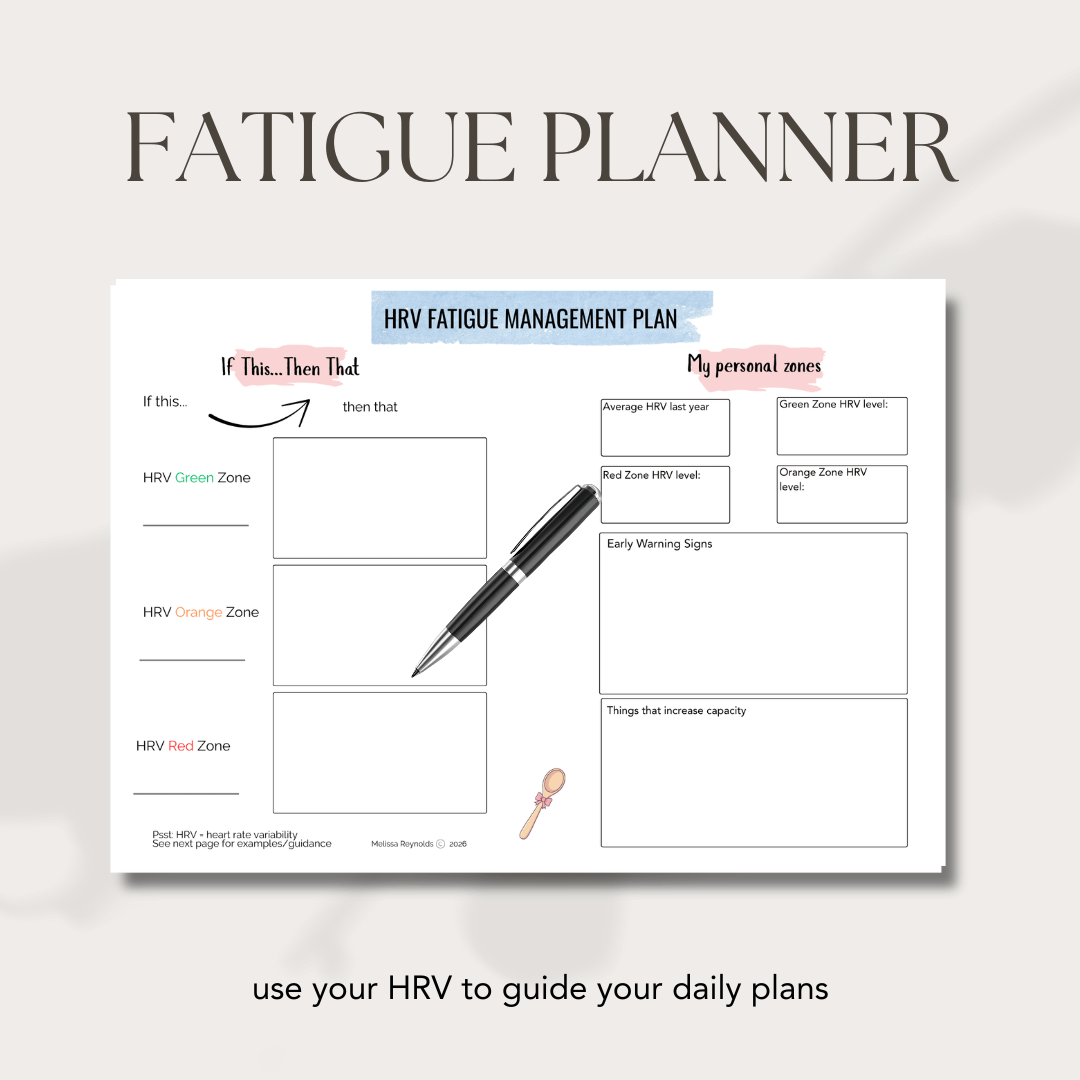
Download:

First, using your wearable fitness device, find your average Heart Rate Variability of the past year.
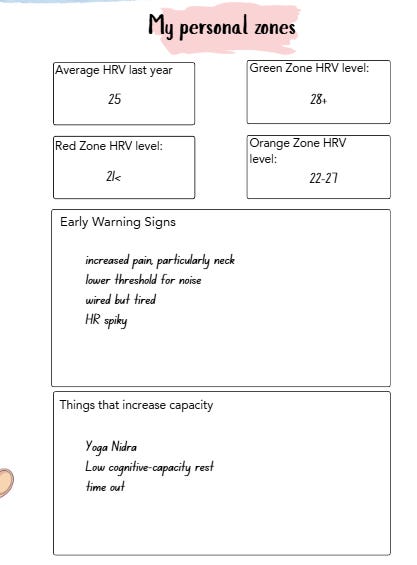
Decide what your zones will be. I suggest making your average HRV for the past year part of your Orange zone. Take a look at your top zone and make that your green.
Write up your early warning signs and the things that increase your capacity.
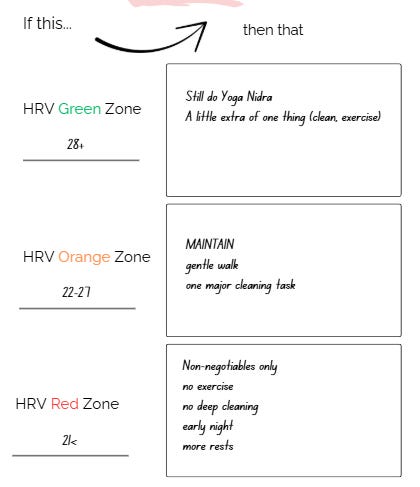
Transfer your HRV zones to the If This Then That side. Start with your Orange Zone. This is your MAINTAIN section - your daily average. What you write here will be highly dependent on what your day usually requires, how well you are and what your current goals are. As a mama of four, my maintain includes a gentle walk and one major cleaning task (so I can keep them broken up across the week).
Next fill in your non-negotiables only day - in other words, treat it like a flare day. This was the biggest change for me - consider 21 or under as a flare day. My non-negotiables include managing the children and doing the bare minimum in the house. I try to take a longer rest, take an early night and avoid exercise or deep cleaning (these jump my heart rate - and I’m usually experiencing spikes without these.)
Remind yourself in your green zone that you will still do your daily tasks to increase capacity. Give yourself one additional thing you will do so you don’t overdo it.
You may like to discuss it with your medical team - anyone who understands your context and ME/CFS (or whatever conditions you live with). You could also discuss it with AI.
You could say something like, “I live with ME/CFS and x, y, z conditions. My average HRV from the past year is x. I would like to create a daily fatigue management plan based upon HRV levels - red, orange and green levels. Could you suggest the range for each level of my traffic light? Orange will include my average HRV and be “maintenance” mode.”
You don’t have to accept the first answers. Challenge the AI with additional context or use it as a guide and make your own.
Context is vital
Context is very important for this. I have walked most days for many years, some days they are very gentle and short, other days they are a little longer. It is part of my “maintenance” mode. Cardio is not usually part of the recommendation for ME/CFS.
Let me know if you find this helpful.
If you loved this and want to share it with a friend, please feel free to share this page.
My Mama's Day in Batteries

When I wrote the My Mama Series, I created a discussion guide to help families take the conversation further.
My Daily Symptom Log Tracker

This tracker is the culmination of years of personal symptom tracking and experimentation. It’s evolved from a simple sheet I copied out each week in a blank notebook.