
Why I Finally Switched to Spreadsheets for Symptom Tracking
How data became even more important to my journey

I have been a paper person my whole life.
Not just for journalling — though yes, absolutely that too — but for everything. Lists, plans, ideas, feelings, recipes I’ll never make. There is something about the act of writing by hand that settles me in a way that typing never quite has. A pen moving across paper feels like thinking. It feels like being present.
So when I tell you I’ve spent the last several months building a suite of digital health tracking spreadsheets — and that I genuinely love them, and that I think they might be some of the most useful things I’ve ever made — I want you to understand that this is not a small thing for me. This is a considered shift. A change of mind that took years of evidence to produce.
Let me tell you why.
The basket problem
I have hypermobility spectrum disorder, ME/CFS, endometriosis, and gut issues that spent years being labelled IBS and are now looking increasingly like IBD. I was also, at one point, diagnosed with fibromyalgia — a diagnosis that was later revised as more information emerged. That revision, by the way, took years. It took years, partly because the symptoms of these conditions overlap so significantly, and partly because I didn’t have the kind of clear, longitudinal data that might have made the picture legible sooner.
I had journals. Lots of them. Pages and pages of how I felt, what hurt, what I couldn’t do, what I tried. All of it beautifully, usefully written — and almost entirely impossible to analyse.
I also had a basket on my bedside table. You might have one too. It’s the basket where the medications live — the ones prescribed across multiple appointments, by multiple doctors, for multiple overlapping conditions. The ones where, if you’re honest, you sometimes pick one up and think: what was this one for again?
That’s not a memory failure. That’s what happens when you’re managing genuine complexity across a healthcare system that sees you in ten-minute windows and doesn’t always talk to itself.
The journals were recording everything. But they couldn’t show me the pattern.
What changed
Two things happened more or less simultaneously.
The first was that I got tired. Not the ME/CFS tired — though yes, always that — but tired in a different way. Tired of arriving at appointments and not being able to remember whether my pain had been better or worse over the last six weeks. Tired of knowing, somewhere in my body, that sleep and symptoms were connected, but not being able to point to anything concrete. Tired of the feeling that I had all this information and nowhere useful to put it.
The second was that the technology genuinely got easier. Spreadsheets used to feel like something accountants did. Something that required expertise I didn’t have. That’s not really true anymore — and it hasn’t been for a while — but it took me some time to fully believe it. Google Sheets, Excel on a tablet, colour coding that updates automatically as you type. It’s accessible in a way it wasn’t ten years ago, even five.
And then there was this: I realised that what I actually needed wasn’t more recording. I was already recording. What I needed was pattern recognition. And patterns require structure. They require consistency. They require being able to look at twelve months of data side by side and see, with your actual eyes, that September is always harder. That your pain scores go up when your sleep goes below six hours. That the weeks after a medical appointment — the exhausting, effortful, cognitively expensive event of a medical appointment — reliably cost you two to three days of recovery.
A journal can hold that information. A spreadsheet can show it to you.
What I built
I ended up creating three tools. I’ll describe them briefly here, because I think the why behind each one matters as much as the what.
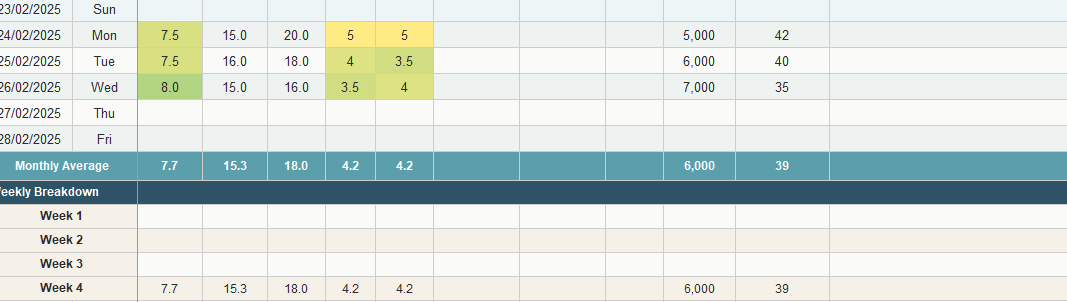
The Spoonie’s Health Tracker came first. It’s a daily tracking spreadsheet — sleep, pain, fatigue, mood, steps, rest, and two symptom columns you name yourself (mine are currently brain fog and gut symptoms). Twelve monthly tabs, one annual dashboard. The dashboard shows all twelve months side by side, colour-coded, so you can see your patterns at a glance rather than hunting through a journal trying to remember if March was bad.
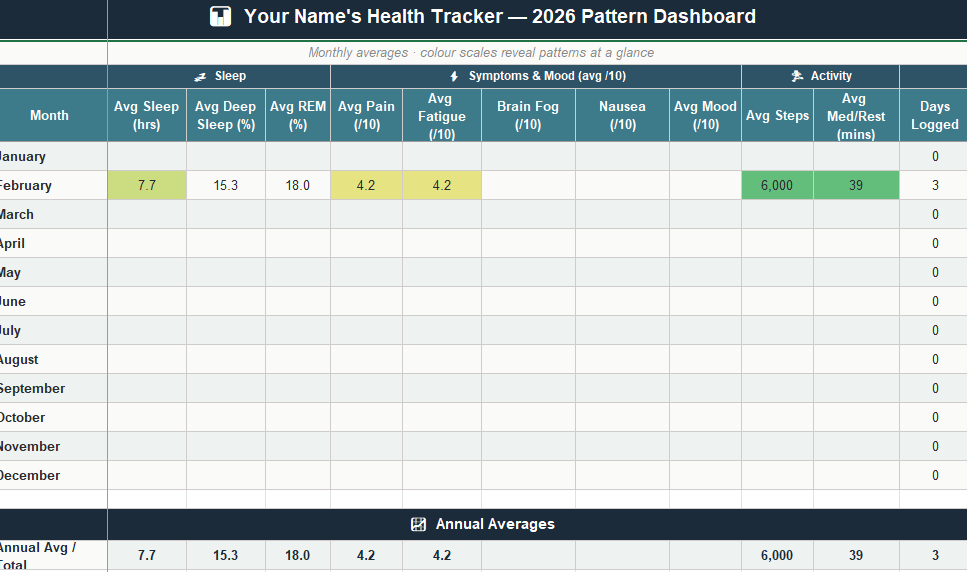
The monthly focus box at the top of each tab was something I added for myself, honestly. Because data without humanity is just numbers, and I needed somewhere to put the month in context. A word, an intention, a note that says this was the month of the difficult appointment or this was the month things started to shift.
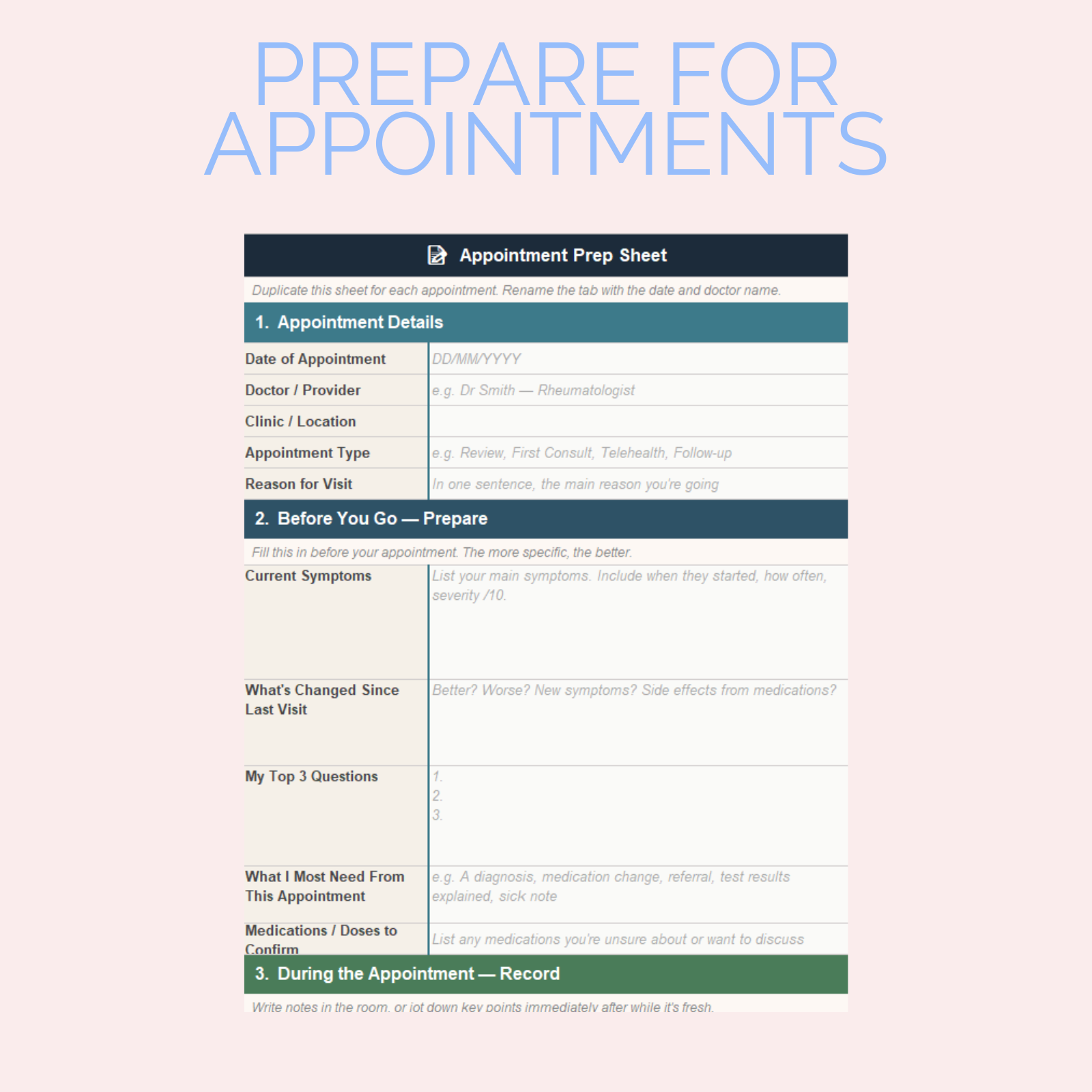
The Medical Appointment Tracker emerged from the years of misdiagnosis. When you see multiple specialists across a long diagnostic journey, things fall through the cracks. A referral gets made and disappears. A medication gets changed, and three months later, you can’t remember which doctor changed it or why. This tracker has an appointment prep sheet — which I fill in before I go in, so I’m not relying on a brain that, frankly, isn’t at its best during a medical consultation — and a full history of every test, referral, and medication change across every appointment I’ve had.
There is a field on the prep sheet called “Things That Were Dismissed or Not Addressed.” I added that deliberately. Keeping a record of what wasn’t followed up on is one of the most powerful advocacy tools available to those of us who have learned, sometimes painfully, that we have to advocate for ourselves.
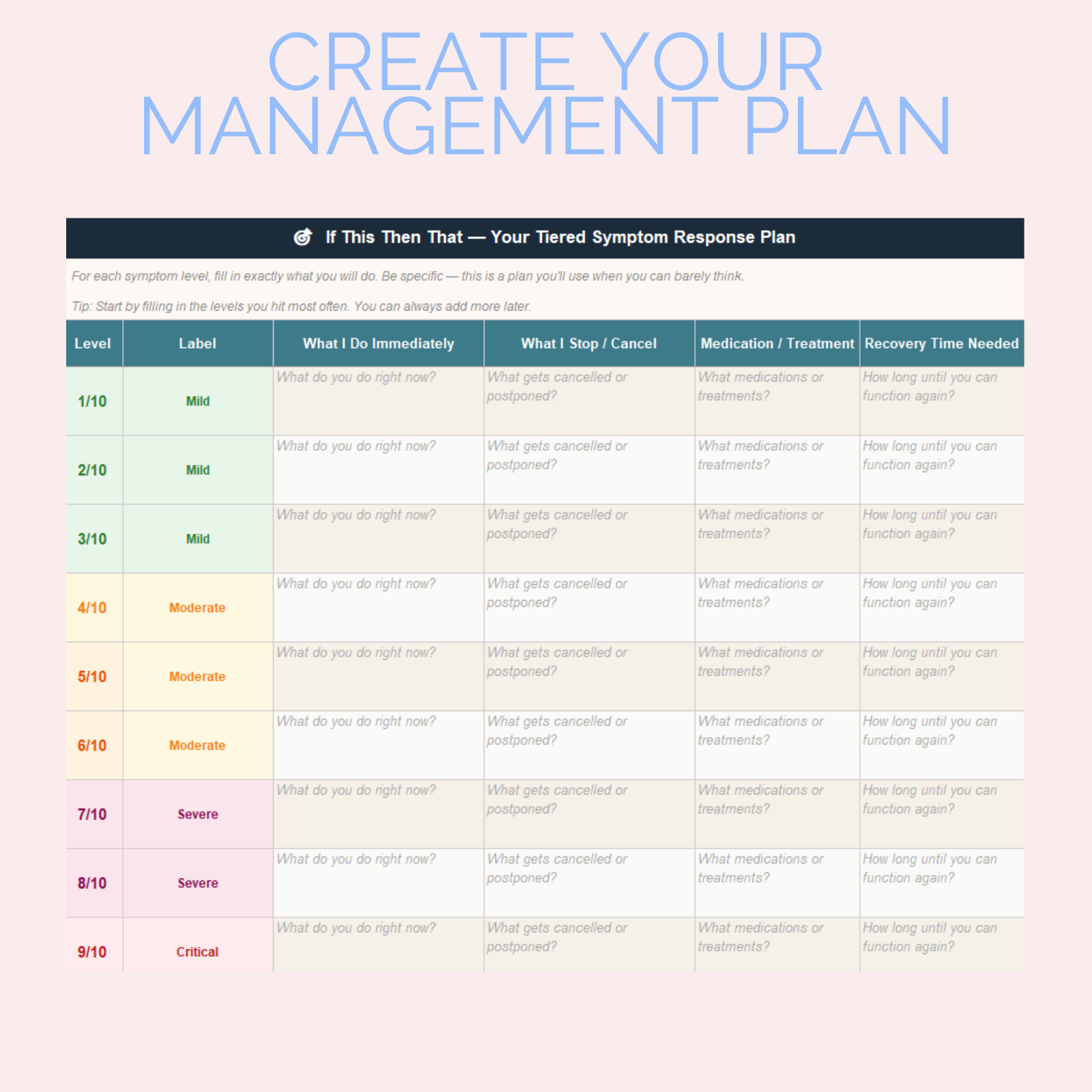
The Symptom Management Planner feels most personal to me. It’s not a tracker — it doesn’t ask you to log anything daily. It asks you to think carefully, when you’re well enough to think clearly, about what your body does, and what you’ll do in response. There’s an If This Then That plan — at a pain level of 4, I do this; at a level of 7, I do that — and a flare plan, a pacing guide, a rescue toolkit, and something I called communication scripts, which are pre-written messages for the situations where finding words is one thing too many. Cancelling plans. Asking for help. Pushing back when a doctor dismisses you.
I built that last one for me as much as for anyone.
What I’ve noticed
I’ve been using these tools for a few weeks now, and a few things have become clear that weren’t before.
My worst weeks are almost always preceded by a run of shorter nights — not dramatically short, just consistently under seven hours for four or five days. That sounds obvious when written down. But I genuinely didn’t know it as a fact until I could see it in a column of numbers with colour-coded levels that go from green to amber to red.
I also know, now, that gut symptom flares and fatigue flares are more correlated than I thought. That’s useful information. That’s the kind of information that belongs in a conversation with a gastroenterologist. I have it because I tracked it, because the tracking is finally in a form that lets me see it.
A note on paper
I still journal. I want to be clear about that. I still have a notebook on my bedside table and I still write in it most mornings, and I still find it to be one of the most grounding things I do. The shift to digital health tracking has not replaced that, and I wouldn’t want it to.
What it has replaced is the attempt to use journalling for something it was never really designed to do. Journals are for processing. For presence. For the texture and feeling of a day, a week, or a year. Spreadsheets are for patterns. For data. For the kind of knowledge that requires distance to see.
I needed both. I just didn’t have the right tool for the second thing — until now.
If any of this resonates
The three tools I’ve described are available in my shop if you’d like to use them. They’re designed to be gentle — you don’t have to fill in every field, you don’t have to use every tab, you don’t have to do anything on the days when doing anything is too much. They’re built for the reality of chronic illness, not an optimistic version of it.
But even if they’re not for you, I hope this is useful as a permission slip of sorts. To try a different system. To stop asking your journal to do something it can’t. To let the tools catch up to the complexity of what you’re managing.
You already know more about your body than most people ever will. It just needs somewhere to live.
— Melissa
The Spoonie’s Health Tracker, Medical Appointment Tracker, and Symptom Management Planner are available in my shop.